Fly or ship your golf clubs to Thailand, Vietnam and South-East Asia?
Thai, Singapore, Emirates and Qatar golf-bag rules, what shipping clubs to South-East Asia costs, customs, caddies and carts, and club hire at the course.
The short answer: fly with them on a full-service ticket.
For most trips to Thailand, Vietnam, Malaysia or Bali, the plane is the cheaper way to bring clubs. Thai Airways, Singapore Airlines, Emirates and Qatar Airways, four of the main long-haul carriers into the region, all carry a golf bag inside your normal checked allowance rather than charging a separate sports fee. If your fare includes a hold bag and the packed case stays within the weight limit, it travels at no extra cost. Shipping is expensive by comparison on routes this long. Luggage Forward’s published example for a standard bag of up to 50 lb, New York to Singapore, is US$359 one way, with standard delivery taking about seven business days. It earns that price in narrower cases: a basic fare with no hold bag, a separate low-cost regional flight in the middle of the trip, or a group that would rather not wheel four heavy cases through two airports in tropical heat.
What Thai, Singapore, Emirates and Qatar allow.
Thai Airways is the most specific. It counts one golf set per passenger within the free allowance, where a set means up to 14 clubs, 12 balls and one pair of golf shoes, provided the total dimensions stay within 330 cm and the weight within your allowance. A second set is charged as excess baggage. Singapore Airlines counts sporting equipment towards your checked allowance and applies its usual additional-baggage charges beyond it. Clubs must travel in a protective bag or hard case, no single checked item may weigh more than 32 kg, and battery-driven golf trolleys are not carried on passenger flights. Emirates also counts golf equipment within the standard allowance, charging excess only if total weight or piece count goes over. On weight-concept fares, which cover most routes to Asia from the UK, no single item may exceed 203 cm in combined length, width and height; on piece-concept fares, used for itineraries that include the Americas, the limit is 300 cm. Qatar Airways carries sporting equipment within the ticket’s allowance, and extra sports allowance costs less bought online before you fly than at the airport.
Hubs and regional hops are where it goes wrong.
The long-haul leg is rarely the problem; the change of plane is. Most golfers reach the courses through Singapore, Bangkok, Doha or Dubai, then fly on to Phuket, Da Nang, Bali or Langkawi, or drive about three hours from Bangkok to Hua Hin, two hours from Ho Chi Minh City to Ho Tram, or cross by ferry from Singapore to Bintan. On one ticket, the bag is normally checked through to the last airport. Thailand’s published arrival rules let passengers connecting from Suvarnabhumi to an airport with its own customs post, such as Phuket, Krabi, Samui or Chiang Mai, have bags through-checked and cleared there rather than in Bangkok. Trouble starts when you add a separate regional booking, often on a low-cost airline. That carrier’s own sports-equipment charge and weight limits then apply, and you collect and re-check the case yourself. Emirates warns that flights operated by other airlines may follow different baggage rules. Check the allowance on every segment, not just the first, and leave a generous connection if you have to re-check the clubs.
Shipping with Luggage Forward: prices, timing and paperwork.
Luggage Forward ships golf bags to more than 200 countries. Its general golf prices start at US$129 for a small bag and US$149 for a large one, but international routes cost more. The clearest published figures for this region are for Singapore: from New York, booked about ten days ahead with standard delivery, a small bag of up to 25 lb starts at US$194, a standard bag of up to 50 lb at US$359, and an oversize bag of up to 75 lb at US$509. Standard delivery takes about seven business days; the preferred service arrives two to three days sooner for a fee. You can book up to 180 days before pickup. The company prepares and submits the customs forms, but you must give an accurate contents list, and any duties or taxes due on arrival are billed to you separately. The on-time guarantee excludes customs holds and weather delays, and incomplete paperwork voids it. The company publishes no separate pages for Thailand, Vietnam, Malaysia or Indonesia, so enter your exact route for a quote.
What you cannot ship, and Thai customs on arrival.
Luggage Forward’s restricted list, as published on its Singapore page, is long. It rules out lithium batteries, which includes rangefinders and tracking devices; pressurised containers, which includes sunscreen; medication and vitamins; food, including coffee and spices; alcohol, with perfume and hand sanitiser counted; tobacco; valuables or currency; and electronics other than cables and converters. Carry those in your hand luggage or buy sunscreen on arrival. Shipped bags must travel unlocked for inspection, though zip ties are fine. If you fly with the clubs into Thailand, customs is straightforward. Passengers with nothing to declare use the green channel; anyone with goods to declare, or unsure whether something is dutiable, must use the red channel. Thailand’s published rules allow personal effects duty free in reasonable quantity up to a value of 20,000 baht. If your bag holds a new, expensive set, keep the receipt with you and ask at the red channel rather than guessing.
Caddies, carts and heat: why a lighter bag works.
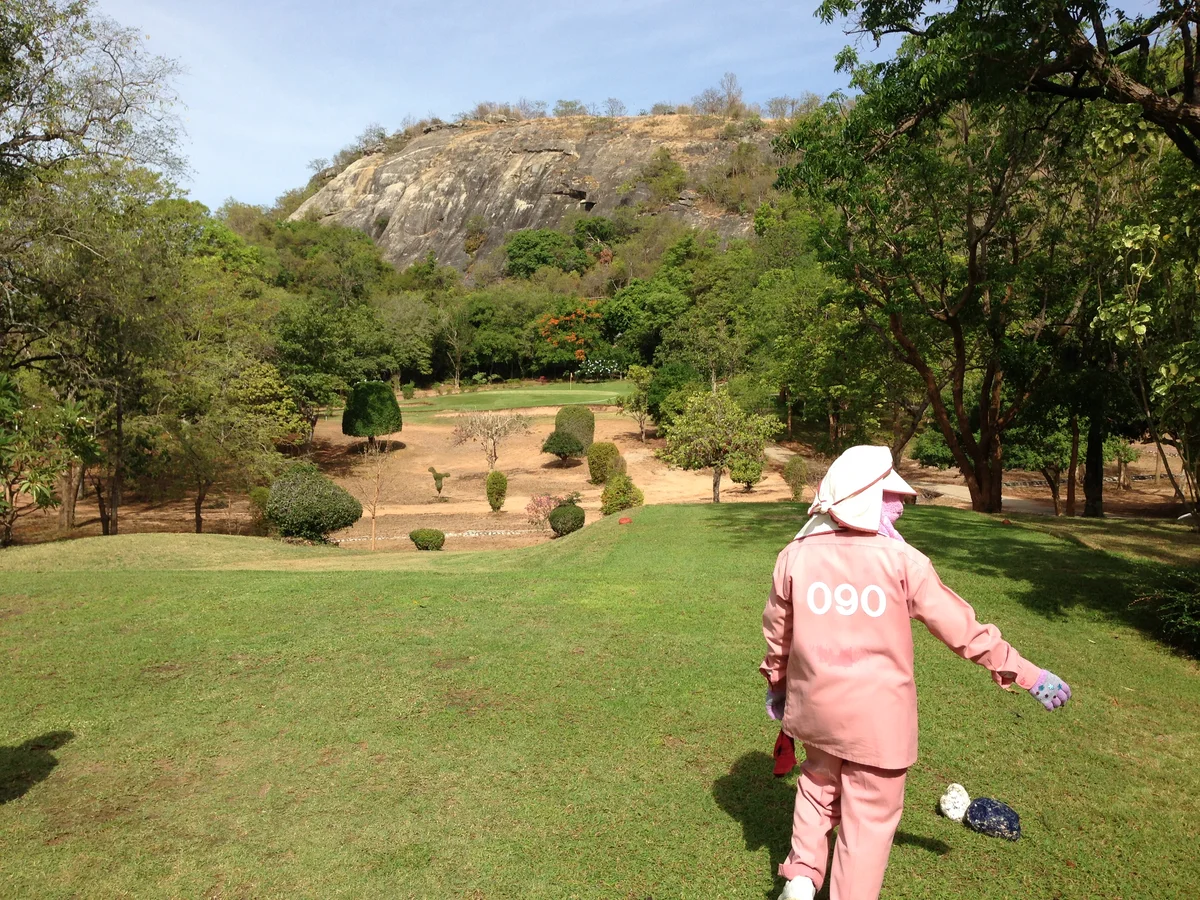
Golf in this part of the world is played with a caddie and, very often, a cart, so you never carry the bag yourself. At Black Mountain in Hua Hin the rates page lists a compulsory cart at ฿750 for 18 holes and a caddie fee of ฿400. At Laguna Lăng Cô on Vietnam’s central coast, the published green fee already includes the caddie fee and a shared cart, though a separate caddie booking fee is listed among the extras. That makes a light stand bag or small cart bag in a soft travel cover the sensible choice. It keeps you well inside airline weight limits and is easier to fit in a hotel car. A lighter bag also leaves room under the weight limit for a rain cover if you are travelling in the wet season.
Renting clubs instead.
Leaving your clubs at home is a realistic option here, because the better courses rent proper sets. Black Mountain lists club rental at ฿1,500 for 18 holes, a third of its ฿4,500 green fee. Laguna Lăng Cô charges ₫900,000 for an 18-hole set or ₫500,000 for nine, and rents single clubs from ₫160,000 for nine holes if you only want to swap in a familiar driver or putter. For a trip with one or two rounds tacked onto a beach holiday, hire costs far less than shipping and spares you the bag at every transfer. If you are playing five or more rounds, or rely on clubs fitted to your swing, bring your own on a through-ticket. Ask for a rental set when you book the tee time, so it is waiting at check-in.
A checklist before you book.
Work through these in order. First, confirm your fare includes a checked bag on every flight, including any regional hop after Singapore, Bangkok, Doha or Dubai. Second, weigh the packed case at home: Singapore Airlines will not take any checked item over 32 kg, and Thai Airways also limits a golf set to 330 cm in total dimensions. Third, make sure one ticket checks the bag through to Phuket, Da Nang, Denpasar or wherever you land. Fourth, if you ship, book at least two weeks ahead to allow seven business days of standard transit plus customs, and send the bag unlocked with an accurate contents list. Fifth, remove rangefinders, trackers and anything with a lithium battery from a shipped bag. Sixth, for a short trip, price a rental set at your course before paying to move your own.
Get a quote for your route.
Enter your home address and the hotel or course in Phuket, Hua Hin, Da Nang or Bali, and Luggage Forward shows the price, transit time and pickup dates before you book.
Get a shipping quoteSponsored link: we may earn a commission at no extra cost to you. How we work